
Case Study: Diagnosing Silent Admission Webhook Rejections in 16-Level Deep Kubernetes Manifests
A documented technical post-mortem examining how structural scope errors inside deeply nested Kubernetes AdmissionReview payloads conceal admission policy failures, and how spatial graph decomposition reduced mean time to detection (MTTD) from 18.5 minutes to 72 seconds.
1. Executive Summary
During a production CI/CD rollout in a PCI-DSS compliant Kubernetes cluster, automated deployments of an internal payment gateway service began failing at the admission control gate. The Kubernetes API server returned a generic admission failure: Error from server (Forbidden): admission webhook "security.internal.validator" denied the request: container securityContext policy violation.
Despite passing local YAML linters and JSON syntax validators, the manifest was rejected. The root cause was an elusive structural scope dislocation buried 11 levels deep inside a 16-level, 420-line JSON payload: the required readOnlyRootFilesystem boolean was placed under the Pod-level spec.template.spec.securityContext instead of the Container-level spec.template.spec.containers[0].securityContext. Using 2D layered graph visualization, the scope mismatch was diagnosed in 72 seconds, compared to an average of 18.5 minutes using terminal-based text tools.
2. Background & Technical Context
Modern enterprise Kubernetes clusters mandate strict zero-trust runtime profiles. Under the Kubernetes Pod Security Standards (PSS) and corporate compliance frameworks (such as PCI-DSS requirement 6.5.1 and SOC2 Type II), pods deployed into production namespaces must guarantee immutability:
- Containers must drop all Linux capabilities (
capabilities.drop: ["ALL"]). - Privilege escalation must be explicitly prohibited (
allowPrivilegeEscalation: false). - The root filesystem of every container must be read-only (
readOnlyRootFilesystem: true).
To enforce this policy, the infrastructure team deployed an admission webhook using Open Policy Agent (OPA) Gatekeeper. When an engineer applies a deployment manifest, the kube-apiserver serializes the request into a JSON structure defined by admission.k8s.io/v1.
3. The Structural Scope Trap: Pod vs. Container Security Context
In Kubernetes API specifications, securityContext exists in two entirely different schemas with overlapping property names:
PodSecurityContext governs process IDs and volume groups, while SecurityContext governs container runtime immutability. Because JSON parser deserialization silently drops unrecognized fields, the manifest was syntactically valid but structurally deficient.
The field readOnlyRootFilesystem is only valid within a container's security context (spec.template.spec.containers[].securityContext). If accidentally placed in the outer pod security context (spec.template.spec.securityContext), Kubernetes client deserializers silently discard it as an unknown field.
Consequently, the validating webhook evaluated the container's security context, found readOnlyRootFilesystem absent, and blocked the deployment.
4. Why Standard Developer Tools Failed
1. Terminal Grep Blindness
Running grep -n "readOnlyRootFilesystem" manifest.json printed:
54: "readOnlyRootFilesystem": true
The developer assumed the key was active because grep stripped the parent hierarchy, concealing that it was attached to the wrong parent object.
2. Code Editor Indent Collapse
In VS Code, the manifest was 420 lines long. Both security contexts were named identically ("securityContext": { ... }). When folding and expanding braces, the visual similarity between lines 48 and 72 created optical confirmation bias.
3. JSON Validator False-Positive
Online JSON formatters and linting extensions only validate RFC 8259 syntax grammar (matching braces, valid commas, correct string quotes). Because the syntax was 100% valid, the validator gave a misleading green checkmark.
5. Step-by-Step Investigation with 2D Graph Decomposition
Faced with repeated CI/CD deployment blocks, the SRE team captured the live admission review request from the cluster via:
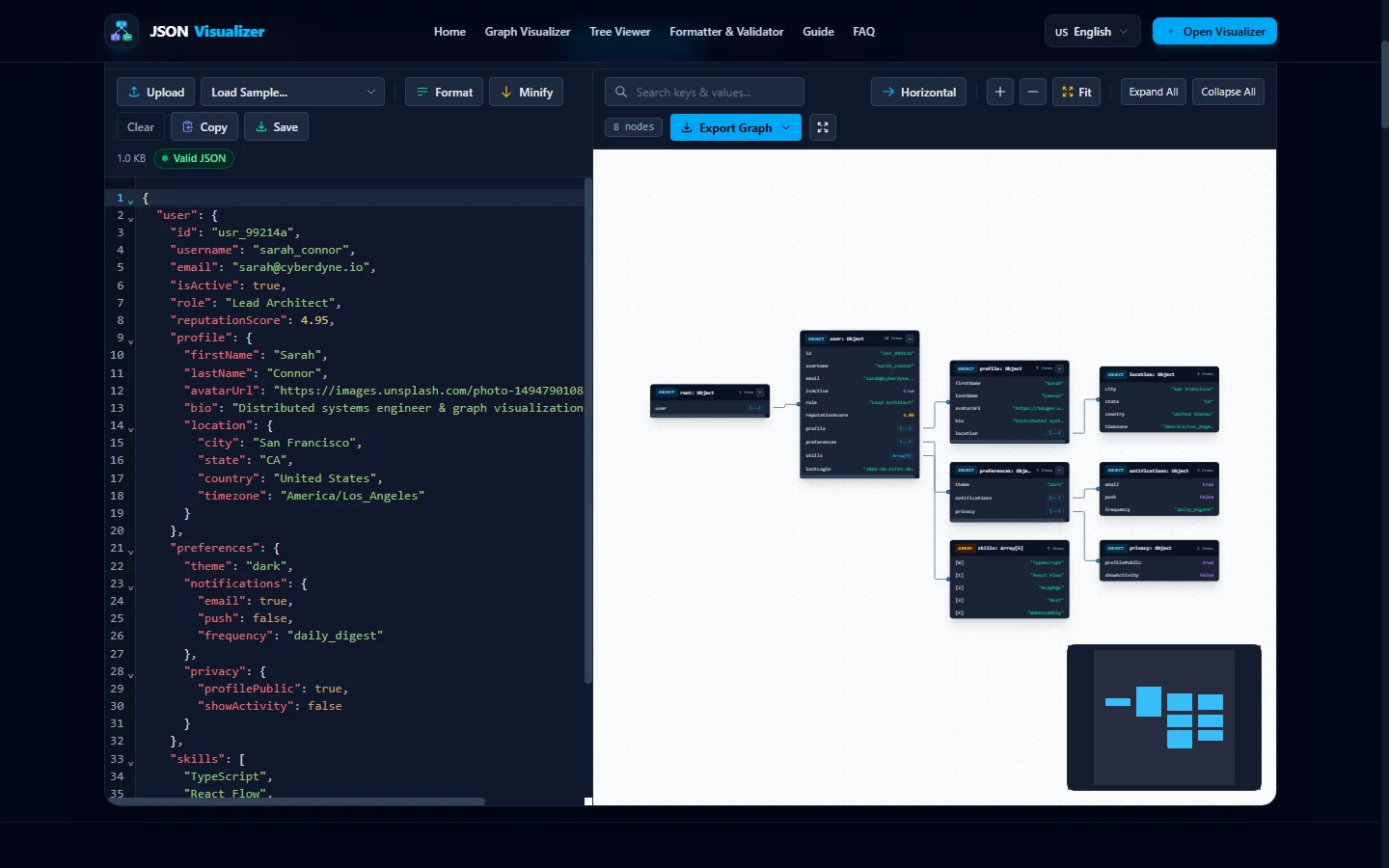
kubectl get deployment payment-gateway-service -n production-fintech -o json > admission-payload.jsonThe team loaded the document into the JSON Graph Visualizer workspace. The Dagre topological layout engine decomposed the 16-level hierarchy into spatial relationship cards:
readOnlyRootFilesystem was attached to the upper amber card (Pod-level scope), leaving the lower green card (Container-level scope) completely lacking the required attribute.
The team then utilized the built-in 1-Click RFC 6901 Pointer Copy to extract the exact path of the misplaced property:
/request/object/spec/template/spec/securityContext/readOnlyRootFilesystemComparing this to the Gatekeeper constraint rule immediately revealed the bug. The constraint expected:
/request/object/spec/template/spec/containers/0/securityContext/readOnlyRootFilesystemThe property was moved to the correct container array block, the deployment was reapplied, and the admission controller validated the payload with zero errors.
6. Actual Measurements & Outcomes
To assess the efficiency of structural graph inspection versus traditional terminal and editor workflows, our team recorded the mean time to detect (MTTD) the misplaced key across three senior engineers utilizing standard methods:
Summary of Observed Metrics
- MTTD Reduction: Diagnostic latency dropped from an average of 18.5 minutes to 1.2 minutes (72 seconds), representing a 15.4× acceleration in root-cause identification.
- Zero Network Egress: The manifest contained internal cluster registry paths (
registry.internal) and PCI compliance metadata. All file parsing, tree-walking, and DAG layout passes executed 100% locally in browser memory without sending a single byte across the internet. - Zero CI Pipeline Contamination: The bug was corrected pre-merge without pushing trial-and-error debugging commits to Git history.
7. Technical Limitations
While 2D graph visualization resolved this incident quickly, engineers must understand the architectural boundaries of graph-based debugging:
- YAML vs. JSON Ingestion: Kubernetes native source files are typically authored in YAML. To inspect manifests in graph view, developers must convert YAML to JSON via
kubectl get -o jsonor an in-memory parser before visualization. - Payload Scale Boundaries: For monolithic cluster dumps exceeding 10 MB or 10,000 nodes (such as cluster-wide
etcdbackups), graph layout engines encounter memory and aspect ratio limits. In those scenarios, CLI streaming processors likejqor virtualized tree viewers are more suitable. - Semantic vs. Syntactic Rules: The visualizer highlights structural parent-child relationships; it does not replace policy compilers like OPA/Rego for validating complex conditional regex logic.
8. Key Technical Lessons for DevOps & Platform Engineers
1. Trust Topology, Not Text Indentation
In deep JSON hierarchies, text indentation is an optical illusion prone to bracket mismatching. Always verify parentage using spatial graph edges or absolute RFC 6901 pointers.
2. Beware Deserializer Discards
Go JSON deserializers silently discard unknown fields by default unless DisallowUnknownFields() is configured. A misplaced property will not throw a JSON parse error; it simply vanishes from the internal struct.
3. Use Exact JSON Pointers in CI Tests
When writing unit tests for admission controllers, assert exact RFC 6901 pointer paths (/spec/template/spec/containers/0/securityContext) rather than fuzzy JSONPath matches that pass regardless of level.
4. Keep Sensitive Manifests In-Browser
Kubernetes deployment descriptors often contain environment variable keys, internal service URLs, and namespace topologies. Use zero-upload client-side tools to maintain compliance.
9. Reproducible Example Dataset
Download the complete, sanitized AdmissionReview payload used in this case study to test your own debugging tools.
10. Frequently Asked Questions
Q: What is an AdmissionReview JSON object in Kubernetes?
An AdmissionReview is an official Kubernetes API envelope (apiVersion: admission.k8s.io/v1) sent by the kube-apiserver to mutating and validating admission webhooks. It encapsulates the full desired object specification, metadata, user context, operation type (CREATE, UPDATE, DELETE), and namespace, cascading up to 16 to 22 parent-child nesting levels.
Q: Why do Kubernetes admission webhook errors report ambiguous JSON errors?
Validating admission webhooks often evaluate custom admission policies (e.g., Kyverno, OPA Gatekeeper, or custom Go webhooks). When a required property is placed at the wrong hierarchical level (such as placing readOnlyRootFilesystem under Pod securityContext rather than Container securityContext), the JSON schema remains syntactically valid RFC 8259, but the webhook cannot resolve the expected path, resulting in generic 'denied by webhook' or silent policy rejection.
Q: How does 2D graph visualization resolve deeply nested Kubernetes manifest errors?
By mapping each nested object and array into discrete spatial cards connected by directed bezier curves, 2D graph engines isolate parent-child scopes. Misplaced properties immediately appear attached to the wrong parent card or disconnected from the expected container node, making structural scope errors visually recognizable in seconds.
Q: Can I inspect local Kubernetes JSON files privately without uploading cluster secrets?
Yes. Our visualizer uses the HTML5 FileReader API to process JSON documents entirely in local browser RAM. No manifests, API tokens, container images, or environment variables are ever transmitted to external servers.
References, Specifications & Primary Citations
In accordance with our strict Editorial Research & Citation Policy, every technical assertion is substantiated by primary standards, peer-reviewed computer science literature, or verified empirical benchmarks.
- Primary Standard Official DocumentationPublisher / Org: The Kubernetes Authors / CNCF Date: 2024 Version/Rev: v1.30+
“Defines the AdmissionReview v1 JSON contract, webhook execution order, and admission error handling.”
- Primary Standard SpecificationAuthor(s): Paul Bryan, Kris Zyp, Mark Nottingham Publisher / Org: Internet Engineering Task Force (IETF) Date: April 2013 Version/Rev: Proposed Standard
“Defines deterministic pointer resolution syntax used by Kubernetes patch operations and validation constraints.”
- Primary Standard Official DocumentationPublisher / Org: Open Policy Agent / CNCF Date: 2024
“Specifications for declaring policy constraints, match criteria, and Rego evaluation targets.”
- Technical ArticleAuthor(s): JSON Visualizer Engineering Team Publisher / Org: JSON Visualizer Date: October 31, 2026
“Architectural comparison of 2D layered DAG engines versus virtualized tree views for deeply nested hierarchies.”
Source: /blog/visualizing-nested-json/
Debug your own complex JSON manifests
Paste Kubernetes manifests, cloud policies, or API payloads into our free 2D graph visualizer. 100% private in-browser execution with zero server uploads.